In a newsroom, the outlet that sends the alert first gets the most engagement. The logic is simple enough that it often becomes the entire mobile engagement strategy: something happens, everyone gets notified… as fast as possible.
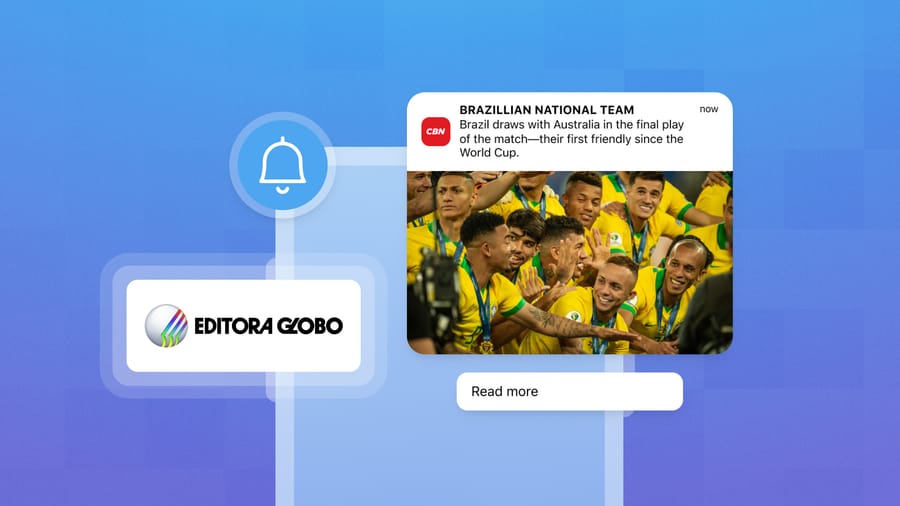
Santiago Carrilho, Head of Technology and Digital Products at Editora Globo, runs messaging for Editora Globo, part of Grupo Globo and works with more than 25 brands, including O Globo and Valor Econômico, two of Brazil’s major newspapers. His team has used OneSignal for more than seven years, across 24+ websites and their main apps.
What stood out in our conversation was how deliberately his team decides which stories earn a broadcast and which should reach only the readers who want them.
Broadcast is for the stories that earn it
On speed, Santiago is unambiguous.
“I can’t imagine distributing a major news story at scale without the push notifications we send through OneSignal.”
During a major break, they reach a very large audience quickly and watch traffic climb in real time. He says the results on urgent news are significantly stronger than for routine content, and that after seven years it still surprises them.
A true breaking story is one of the few moments when every reader wants the same thing at once. Then the day goes back to normal, and the way you message has to change with it.
Everything else is personalized
Most of a news day is not a major break. For subjects like the economy or politics, Editora Globo sends according to each person’s interests. Santiago describes the problem from the reader’s side of the screen: people receive alerts on their phones constantly, and that volume can become intrusive. When it does, a story someone genuinely wanted can get lost among the ones they didn’t.
The more precisely they segment, the higher their conversion rate compared with sending a mass breaking-news alert to everyone.
Santiago shares that they use AI to understand what each person is interested in and when they’re most likely to engage, then trigger a Journey to reach that person at the right time. They’re also exploring in-app messaging in their apps and Live Activities, with the goal of being present in their users’ everyday lives.
What this means for your own alerts
Segmentation usually gets sold on conversion, and Editora Globo’s experience backs that up. However, alerts land on people’s phones constantly, and when too many are irrelevant, the story a reader actually wanted gets lost among them.
Your biggest alerts will land better when your everyday ones are chosen with care. Here’s how to put that into practice.
- Audit your last 30 days of sends to everyone. Count how many were genuinely urgent to most of your audience. The gap between that number and your total is the volume working against your best alerts.
- Write down the bar for a broadcast. Choose a test your team can apply quickly, such as “this would change what most of our audience does today.” Anything below it goes to the readers who’ve shown interest in that topic.
- Start with one topic. Pick a recurring topic and send it only to people who’ve engaged with it before. Compare conversion against your usual mass alert for similar stories, and watch how your breaking-news sends perform as you trim. Santiago’s team found conversion rose as their segments got more precise.
- Keep the broadcast path short. Decide who can approve a breaking alert and how it goes out, so it can move in minutes. The less that has to happen between “this is big” and “sent,” the more often you’ll be first.
Protect the alerts that matter
A news alert has a short window and a long memory. Send it fast enough and you win the moment. Send too many that weren’t needed, and readers remember that instead. Editora Globo’s approach pairs a quick path for the stories everyone needs with interest-based routing for the rest, and the same split works for scores, market moves, or anything else that loses value as time passes.
OneSignal’s segments and Journeys can handle the setup on every channel across your app, and one topic is enough to start.
Get Started for Free